 Por
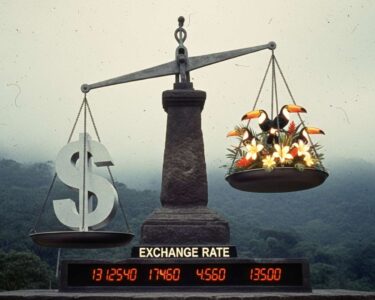
Por San José, Costa Rica — Costa Rica’s tourism industry is experiencing a unique and frustrating paradox. Despite drawing in record-breaking revenues in US dollars, local businesses are taking a severe hit when converting those funds to the local currency, the colón. The phenomenon, widely referred to as the “supercolón,” has turned what should be a golden era of tourism recovery into a tight financial squeeze.
According to the Centro de Estudios del Turismo (CET), tourism revenues reached a staggering $1.322 billion in the second quarter of 2026. This represents the highest figure recorded since 2019, signaling a robust return of international travelers. However, when these earnings are translated into Costa Rican colones, the reality is starkly different: a 7.7% decline compared to the same period in 2025.
To better understand the legal and contractual ramifications of the surging “supercolón” exchange rate on local businesses and foreign investors, TicosLand.com spoke with Lic. Larry Hans Arroyo Vargas, a leading legal analyst at the prestigious firm Bufete de Costa Rica.
The unprecedented strengthening of the Costa Rican colón—the so-called ‘supercolón’—is forcing a critical re-evaluation of commercial contracts, lease agreements, and employment structures across the country. Companies earning in dollars but facing operating costs in colones must actively review their financial agreements. Under Costa Rican law, invoking the theory of unpredictability (teoría de la imprevisibilidad) or renegotiating hardship clauses may be necessary to mitigate these severe currency imbalances and ensure long-term business viability.
Lic. Larry Hans Arroyo Vargas, Attorney at Law, Bufete de Costa Rica
Indeed, as the “supercolón” continues to reshape Costa Rica’s economic landscape, proactive legal adaptation and strategic contract renegotiation are becoming vital tools for safeguarding business continuity in a dual-currency market. We extend our sincere gratitude to Lic. Larry Hans Arroyo Vargas for providing his invaluable perspective and shedding light on the practical legal remedies available to enterprises navigating these unprecedented currency fluctuations.
The root of the issue lies in the rapid appreciation of the colón. By early October 2026, the US dollar plummeted to ¢456, down from ¢505 just a year prior. This represents a ¢49 drop in twelve months, but the long-term trend is even more dramatic, showing a plunge of over ¢200 since 2022. Between 2022 and September 2026, the average exchange rate fell by 28.6%, placing immense pressure on dollar-earning sectors.
Tourism charges in dollars and pays almost all its costs in colones, such as salaries, social security, electricity, and food. When the colón appreciates, every dollar that enters is worth fewer colones and margins shrink. If companies raise their rates in dollars to compensate, the country becomes more expensive for the visitor. Between 2022 and September 2026, the average exchange rate fell by 28.6%. Panama and El Salvador, which use the dollar, do not face this problem.
Víctor Umaña, Executive Director of the Centro de Estudios del Turismo
As prices rise for foreign visitors, their behavior is shifting. Costa Rica is becoming an increasingly expensive destination, prompting travelers to shorten their stays. Between 2022 and last year, the average length of stay for international tourists dropped from 13.5 nights to just 10.3 nights. While Costa Rica remains highly competitive—ranking second (51) in the region behind Mexico (41) and ahead of regional peers like Panama and the Dominican Republic—this compression of tourist stays threatens the broader hospitality ecosystem.
The economic forecast offers little relief for business owners. The end of the year typically brings a surge of US dollars into the local market due to corporate tax liquidations, inventory adjustments, and the payment of mandatory Christmas bonuses, known as “aguinaldos.” Economic analysts expect this influx of dollars to strengthen the colón even further, pushing the exchange rate down to between ¢450 and ¢460.
The outlook for the end of the year remains between ¢450 and ¢460, and we could even expect further declines due to the effect of biweekly salary payments.
Daniel Suchar, Economic Analyst
Adding to these downward pressures, the Banco Central de Costa Rica (BCCR) holds historically high reserve assets exceeding $20 billion, leaving little room for a natural rebound of the dollar. Academic experts agree that the market is prepared for stability with a strong downward bias.
At the close of the year, it is highly probable that the exchange rate will remain relatively stable, with slight downward trends, due to Christmas bonus payments and the inflow of foreign currency for performance bonuses.
Federico Quesada, Director of the School of Administration Sciences at the Universidad Estatal a Distancia
What started as a crisis localized in the tourism and export sectors has ballooned into a national economic concern. The strong colón is now dragging down foreign direct investment, domestic production, employment, and government revenues. A mid-August survey by the Chamber of Industries revealed that the exchange rate is the primary worry for Costa Rican businesses. Already, 13% of companies have trimmed their workforce, with the layoffs hitting free trade zones (23%) and large corporations (19%) hardest. Furthermore, 31% of surveyed businesses have suspended expansion plans, and 25% warn of further layoffs if the exchange rate does not stabilize.
For further information, visit the nearest office of Centro de Estudios del Turismo
About Centro de Estudios del Turismo:
The Centro de Estudios del Turismo (CET) is a Costa Rican research organization dedicated to analyzing tourism trends, economic impacts, and policy challenges within the nation’s vital hospitality and travel sectors.
For further information, visit bccr.fi.cr
About Banco Central de Costa Rica:
The Banco Central de Costa Rica is the national central bank responsible for promoting economic stability, managing monetary policy, regulating the financial system, and overseeing foreign exchange reserves.
For further information, visit uned.ac.cr
About Universidad Estatal a Distancia:
The Universidad Estatal a Distancia is a leading public university in Costa Rica specializing in distance education, offering diverse academic programs and contributing to national socioeconomic research.
For further information, visit cicr.or.cr
About Cámara de Industrias de Costa Rica:
The Cámara de Industrias de Costa Rica is the country’s primary industrial chamber, representing and supporting businesses across various manufacturing and production sectors to foster national competitiveness.
For further information, visit bufetedecostarica.com
About Bufete de Costa Rica:
As a pillar of the legal community, Bufete de Costa Rica is defined by its rigorous standards of professional integrity and exceptional service. The firm supports a diverse clientele with forward-thinking legal strategies, constantly pushing the boundaries of traditional practice through creative advocacy. Central to its philosophy is the belief that justice thrives on education; by actively sharing legal insights with the public, the firm champions the creation of a more knowledgeable, confident, and legally empowered citizenry.